PoliStack Briefs
Every brief starts with a single question
PoliStack connects bills, campaign finance, lobbying, votes, committees, and members — then assembles a complete, source-linked intelligence brief in one run. No manual stitching. No back-and-forth.
Add the PoliStack connector in Claude to access the political knowledge graph.
Add the PoliStack Brief skill once. It defines the structure, analysis, and output format.
Ask about a bill, donor network, stakeholder fight, or policy area — and PoliStack assembles the full brief.
A single skill file for Claude. Add it once, ask your question, and generate a full intelligence brief. Members only.
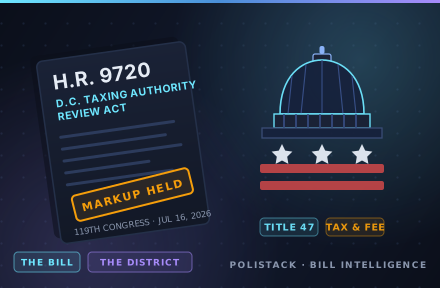 LEGISLATIVE ANALYSIS: 07/23/26
H.R. 9720 — D.C. Taxing Authority Review Act: Congressional Review of District Taxation
H.R. 9720, the D.C. Taxing Authority Review Act, amends the District of Columbia Home Rule Act to flip the default on District tax law: Acts codified in title 47 of the D.C. Code, or that impose or increase any tax or fee, could no longer take effect after the standard congressional review period unless Congress affirmatively passes a joint resolution of approval. Oversight Chair James Comer (R-KY-1) introduced it on July 16, 2026 with 21 Republican cosponsors; it was referred to his own committee (lead) and to Rules.
Legislative Analysis·9 min read·Read brief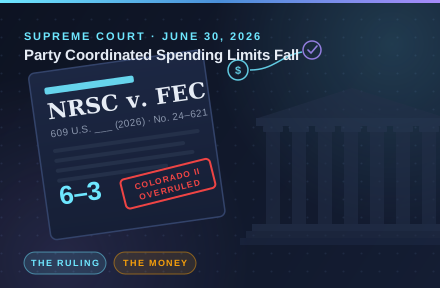 MONEY IN POLITICS: 07/04/26
NRSC v. FEC — Coordinated Party Spending Limits Struck Down: Money in Politics
On June 30, 2026, the Supreme Court held 6–3 in NRSC v. FEC that FECA's limits on political-party coordinated expenditures violate the First Amendment, overruling Colorado II (2001). National and state party committees may now spend without limit in coordination with their candidates. The decision leaves contribution limits, earmarking rules, and disclosure requirements in place — and arrives four months before the 2026 midterms.
Money in Politics·9 min read·Read brief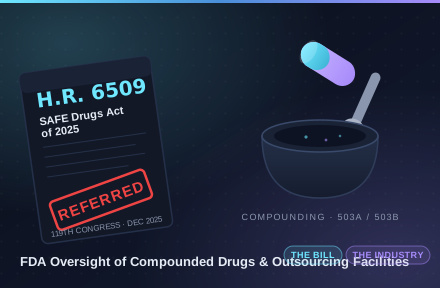 LEGISLATIVE ANALYSIS: 06/25/26
H.R. 6509 — SAFE Drugs Act of 2025: Compounding Pharmacy & Outsourcing Facility Oversight
H.R. 6509, the SAFE Drugs Act of 2025, amends the Federal Food, Drug & Cosmetic Act to tighten oversight of drug compounding and set statutory limits on compounded drugs that are essentially copies of commercially available products. Rep. Rudy Yakym (R-IN-2) introduced it on December 9, 2025 with Democratic co-lead Rep. André Carson (D-IN-7) and 16 cosponsors. It was referred to House Energy & Commerce, where every one of nine semantically comparable drug-safety bills has died in committee.
Legislative Analysis·9 min read·Read brief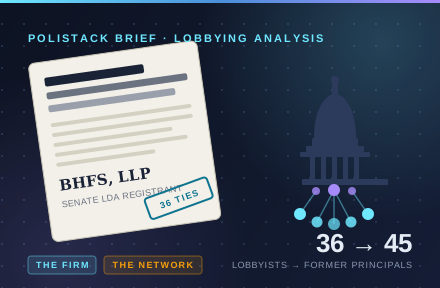 LOBBYING ANALYSIS: 06/12/26
Lobbying Activity Profile: Brownstein Hyatt Farber Schreck — Revolving-Door Access Map
Brownstein Hyatt Farber Schreck — the Senate LDA registrant with the largest disclosed federal lobbying revenue — employs 485 professionals, of whom 237 disclose prior federal government service: former Assistant Secretaries of State and the Treasury, a Cabinet-secretary chief of staff, the Staff Director of the Senate Finance Committee, and White House and NSC aides. Within that bench, 36 LDA-registered lobbyists disclose covered-position ties to 45 members of Congress across 48 disclosed ties — 26 still seated in the 119th Congress, 15 on committees matching the firm's five most-addressed 2025–26 issue areas.
Lobbying Analysis·13 min read·Read brief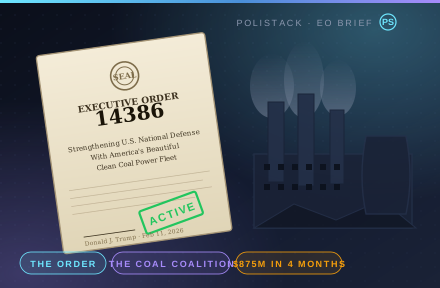 EXECUTIVE ORDER ANALYSIS: 06/04/26
EO 14386 — America's Beautiful Clean Coal: National Defense Power Purchase Agreements
Executive Order 14386, signed February 11, 2026 and published in the Federal Register on February 17, directs the Department of War (formerly DoD) and Department of Energy to procure long-term Power Purchase Agreements from the U.S. coal-fired fleet to serve military installations and mission-critical facilities. The order builds on a chain of four prior energy-emergency EOs and has been operationalized within four months by $875M in DOE awards across 16 coal projects, a new West Coast export terminal, and an emergency order keeping Florida's Stanton Energy Center Unit 1 online through summer 2026.
Executive Order Analysis·9 min read·Read brief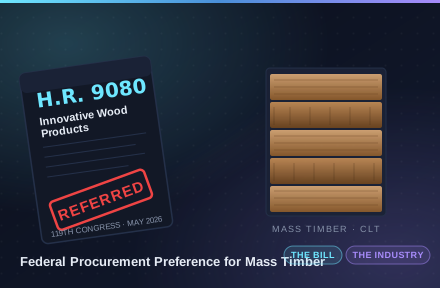 LEGISLATIVE ANALYSIS: 06/02/26
H.R. 9080 — Innovative Wood Products in Public Buildings: Federal Procurement Preference
H.R. 9080 would direct the federal government to favor public buildings constructed with innovative wood products — cross-laminated timber, mass timber, and similar engineered systems — when awarding construction contracts. Rep. Glenn Thompson (R-PA-15) introduced the bill on May 29, 2026 with a single Democratic cosponsor, Rep. Andrea Salinas (D-OR-6). The bill is a thin, targeted procurement preference rather than a regulatory overhaul — but every semantically comparable bill introduced in the last five Congresses died in committee.
Legislative Analysis·7 min read·Read brief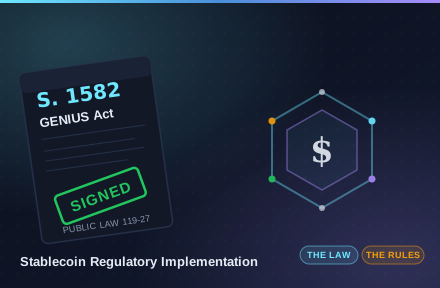 LEGISLATIVE ANALYSIS: 05/28/26
S. 1582 — GENIUS Act: Stablecoin Regulatory Implementation
S. 1582, the GENIUS Act, is the first federal payment-stablecoin framework — signed into law as Public Law 119-27 on July 18, 2025. The fight did not end at enactment; it moved to five federal regulators now writing 14 implementing rules. Of roughly 95 organizations on the rulemaking record, the overwhelming majority support the law but want it modified — and the modifications cluster on one provision.
Legislative Analysis·9 min read·Read brief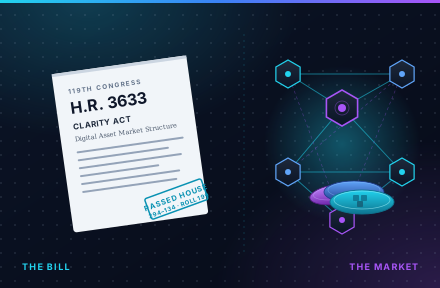 LEGISLATIVE ANALYSIS: 05/16/26
H.R. 3633 — CLARITY Act: Digital Asset Market Structure
HR 3633, the Digital Asset Market Clarity Act of 2025, divides digital-asset oversight between the SEC and CFTC. The House passed it 294–134 on July 17, 2025; the Senate Banking Committee ordered it reported favorably on May 14, 2026. The single most informative pattern in the data: the bipartisan cosponsor list was bought before the bill existed — crypto super PACs spent $4.4M+ in 2024 supporting seven candidates who subsequently became HR 3633 cosponsors.
Legislative Analysis·12 min read·Read brief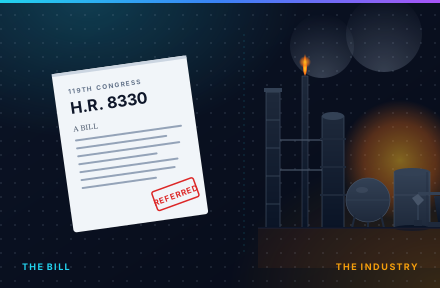 LEGISLATIVE ANALYSIS: 05/15/26
H.R. 8330 & S. 4340: A Coordinated House–Senate Liability Shield for Big Oil
On April 16, 2026, Rep. Hageman (R-WY) and Sen. Cruz (R-TX) introduced identical bills to immunize fossil-fuel companies from climate-damage lawsuits. This brief connects the bill text, the cosponsors, the trade associations whose member companies wrote the rule, and the PAC money flowing into every signature on it.
Legislative Analysis·15 min read·Read brief